Utah weather is hard on exterior walls. Freeze-thaw cycles in the winter, dry heat in the summer, and those sudden spring storms that roll off the mountains all take a toll on the stucco-like finish that covers a lot of homes from Logan down to St. George. If your home has EIFS, which stands for exterior insulation and finish system, you already know it looks solid right up until it isn't. Siding Salt Lake City works with Utah homeowners every week, and most of the calls we get start with a small thing the homeowner almost ignored.
This post walks through the signs that an EIFS problem needs attention soon, not someday. It also covers what you can safely do while you wait for our team to get out to you. You can reach us by phone, and we will talk through what you are seeing before anyone shows up.
Why EIFS problems hide until they are big
EIFS is a layered system. There is foam insulation board, a base coat with mesh embedded in it, and a finish coat on the outside. The foam is what keeps your heating bill reasonable, and it is also what lets water get trapped if the seal breaks somewhere.
Water rarely enters through a big obvious crack. It usually sneaks in at a window corner, a caulk line that has dried out, or a spot where the finish meets a roof edge. Once moisture sits behind the foam, the wall keeps taking on water quietly. By the time the surface looks bad, the damage underneath has often been growing for a while.
That is why the early signs matter so much. Catching them in the first season can mean a repair that stays small. Waiting can turn a few square feet into a wall.
The signs that mean call us soon
Not every blemish is an emergency. Some are just cosmetic. These are the ones we tell Utah homeowners to take seriously:
- Soft or spongy spots. Press gently with your palm. If the wall gives or feels hollow, moisture is likely behind the finish.
- Bulging or puffy areas. A section that stands slightly proud of the wall, or that feels different from the surrounding area, often means the layers have separated.
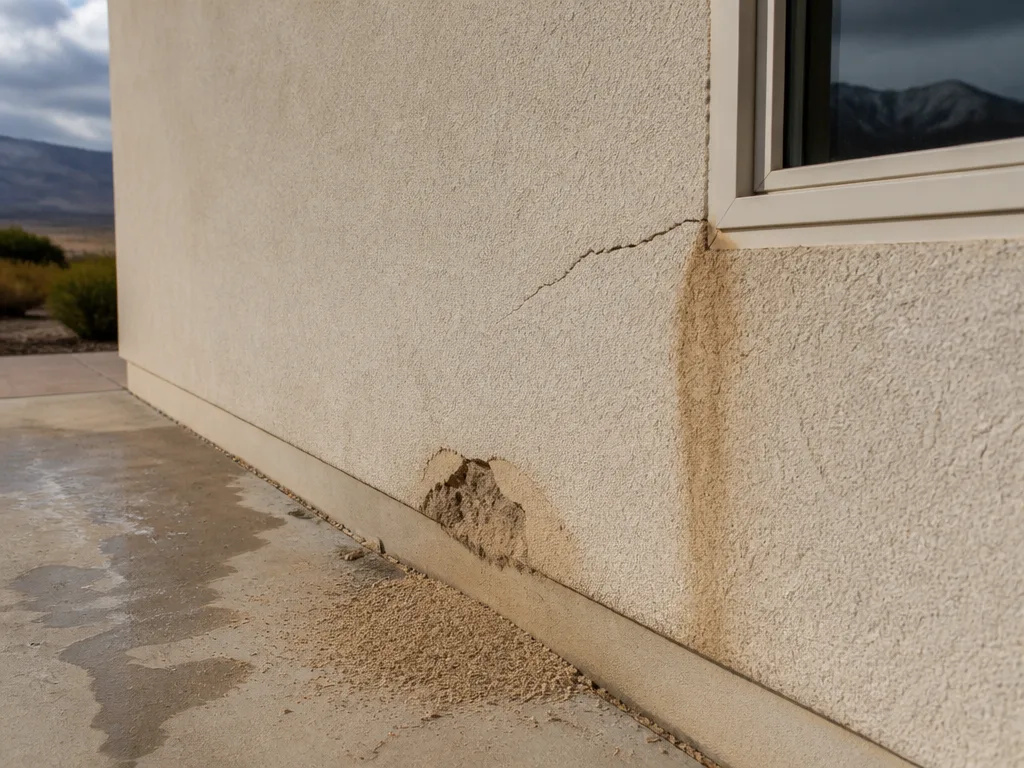
- Cracks wider than a hairline. Fine surface cracks happen. Cracks you can slide a fingernail into, or cracks that run in a straight line from a window corner, need a closer look.
- Dark staining or discoloration. Brown, gray, or greenish patches that show up after rain are a red flag. Do not assume it will dry out on its own.
- Gaps at joints and penetrations. Look where the wall meets windows, doors, decks, and the roofline. Dried or cracked sealant there is one of the most common entry points we see.
- A musty smell indoors. If an interior wall near an exterior section smells damp, water may already be getting past the system.
If you see two or more of these in the same area, treat it as urgent. A single cosmetic crack in a sunny spot is different from a soft patch under a dark stain beside a window.
Check the spots people usually miss
Walk the perimeter once a month, and pay extra attention after big wind or hail. Look at the bottom edge of the wall near the ground, where sprinkler water and splash-back hit hardest. Check the underside of eaves and any place where two surfaces meet at an angle. Those corners collect water and hold it longer than flat wall does.
What to do while you wait for help
Getting a siding specialist out to the house takes a little time, and during that window you can protect the wall without making things worse. Here is what helps and what does not.
Start by taking clear photos. Shoot the wide view of the wall, then close-ups of any crack, stain, or soft spot. Put a coin or a tape measure next to the damage so the scale shows. Date the photos. If the problem grows, those pictures show the timeline, and they make the phone conversation with us much easier.
Next, redirect water. Adjust sprinklers so they do not hit the wall, and move downspout extensions so runoff lands well away from the foundation and the affected section. If there is a planter bed against the wall, pull mulch back a few inches so the base of the wall can dry out.
You can also cover a small, obvious opening with heavy plastic sheeting held loosely with painter's tape. Keep it off the surface if possible so it does not trap moisture. This is a short-term step only. Remove it once a siding specialist has looked at the area, and do not leave plastic up through a wet week.
What to avoid
Do not pressure wash the damaged area. The force can drive water deeper into the system and tear the finish further. Skip the caulk gun on large cracks too. A quick bead of sealant over a problem that needs the layers opened up just traps the water inside and hides it from view. Do not poke at soft spots with a screwdriver either. You will create new entry points, and you will make the repair larger.
Keep ladders and climbing to a minimum. If the damage is high on the wall, a fall is a far bigger risk than a few more weeks of waiting on a small crack. Stay on the ground and take your photos from there.
How our team approaches an EIFS repair
When a Utah homeowner calls us about EIFS, we start by asking what they are seeing and where. We want to know about the weather in the last few weeks, whether the damage is near a window or along a roofline, and whether the inside of the home shows any signs of moisture. That information helps us plan the visit so the right people and materials are ready when the crew arrives.
On site, our team looks at the full area, not just the spot that caught your eye. Water tends to travel, so the visible damage is often only part of the story. We open up what needs opening, dry the substrate where it is wet, and rebuild the layers in the right order. Finish coats are matched to the existing color and texture as closely as the job allows, which matters a lot on a home you plan to keep for years.
We serve homeowners across the state, from the Wasatch Front to the southern valleys and the communities in between. Wherever you are in Utah, the process is the same. You call, we listen, and we schedule the visit in a way that makes sense for your home and your week.
Next steps if you think it is urgent
If you have read this far and recognized something on your own wall, do three things today. Take the photos. Redirect the water. Then give Siding Salt Lake City a call and describe what you are seeing. The earlier we hear about a soft spot or a shifting seam, the more options you usually have.
EIFS is not a material you need to panic about, but it is one you should not ignore. A few hours of attention now can keep a small repair small. That is the whole point of catching it early, and it is why we want Utah homeowners to pick up the phone the first time they notice something off.